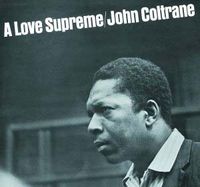
A Love Supreme is a jazz studio album recorded by John Coltrane's quartet in December 196413 and released by Impulse! Records (catalogue number AS-77) in February 1965. It is generally considered to be among Coltrane's greatest works, as it melded the hard bop sensibilities of his early career with the free jazz style he adopted later.
Background
The quartet recorded the album in one session on December 9, 1964, at the Van Gelder Studio in Englewood Cliffs, New Jersey. Coltrane's home in Dix Hills, Long Island, has been suggested as the site of inspiration for A Love Supreme.14
Music
The album is a four-part suite, broken up into tracks: "Acknowledgement" (which contains the mantra that gave the suite its name), "Resolution", "Pursuance", and "Psalm." It is intended to be a spiritual album, broadly representative of a personal struggle for purity, and expresses the artist's deep gratitude as he admits to his talent and instrument as being owned not by him but by a spiritual higher power.14
The album begins with the bang of a gong (tam-tam), followed by cymbal washes. Jimmy Garrison follows on bass with the four-note motif which structures the entire movement. Coltrane's solo follows. Besides soloing upon variations of the motif, at one point Coltrane repeats the four notes over and over in different modulations. After many repetitions, the motif becomes the vocal chant "A Love Supreme", sung by Coltrane (accompanying himself via overdubs).15
In the final movement, Coltrane performs what he calls a "musical narration" (Lewis Porter describes it as a "wordless 'recitation'")16 of a devotional poem he included in the liner notes. That is, Coltrane "plays" the words of the poem on saxophone, but does not actually speak them. Some scholars have suggested that this performance is a homage to the sermons of African-American preachers.17 The poem (and, in his own way, Coltrane's solo) ends with the cry "Elation. Elegance. Exaltation. All from God. Thank you God. Amen." 18
Reception and influence
The impact of A Love Supreme has been extensive enough to encourage the founding of a church—the St. John Will-I-Am Coltrane African Orthodox Church of San Francisco. This iconic depiction of Coltrane as a saint is based on the style of Byzantine art.
A Love Supreme is often listed amongst the greatest jazz albums of all time.192021222324 It was also quite popular for a jazz album, selling about 500,000 copies by 1970, a number far exceeding Coltrane's typical Impulse! sales of around 30,000.25 As further testimony to the recording's historic significance, the manuscript for the album is one of the National Museum of American History's "Treasures of American History", part of the collection of the Smithsonian Institution.26 In 2003, the album was ranked number 47 on Rolling Stone magazine's list of the 500 greatest albums of all time.27 The publication called it a "legendary album-long hymn of praise" and stated "The indelible four-note theme of the first movement, 'Acknowledgment,' is the humble foundation of the suite. But Coltrane's majestic, often violent blowing (famously described as 'sheets of sound') is never self-aggrandizing. Aloft with his classic quartet..., Coltrane soars with nothing but gratitude and joy. You can't help but go with him."27 The Penguin Guide to Jazz selected this album as part of its suggested "Core Collection" and awarded it a "crown" stating "It is without precedent and parallel, and though it must also be one of the best loved jazz records of all time it somehow remains remote from critical pigeonholing" calling it "immensely concentrated and rich."28
The album's influence has been extensive and diverse. Musicians ranging from tenor Joshua Redman29 to the rockstar Bono of U2 30 have singled out the influence of the album on their own work. Guitarists John McLaughlin and Carlos Santana have each cred the album as one of their greatest early influences.31
Other performances
An alternative version of "Acknowledgement" was recorded the next day on December 10. This version, which included tenor saxophonist Archie Shepp and bassist Art Davis, did not feature Coltrane chanting "a love supreme," one reason he chose to issue the quartet version.32
The only live performance of the "Love Supreme" suite, from a July 26, 1965, performance at the Festival Mondial du Jazz Antibes, Juan-les-Pins, France, was also remastered and released in a 2002 two-CD set by Impulse! Records with the original album and additional studio outtakes. This performance was considerably more dissonant than the studio version, and features an extended drum solo preceding the bass solo on "Pursuance".
Adaptations
Doug Carn and wife Jean Carn did a cover of "Acknowledgement" featuring vocals by Jean. This was featured on the album Infant Eyes in 1972. John McLaughlin and Carlos Santana recorded a guitar version of "Acknowledgement," which they titled as "A Love Supreme" on their 1973 collaboration Love Devotion Surrender. At the time, both were devotees of guru Sri Chinmoy.
Will Downing released an R&B cover version of the main theme, with the co-operation of John's widow Alice Coltrane, which reached number fourteen in the UK singles chart in 1988. Gumball recorded a rock/alternative/jazz version of A Love Supreme and was a bonus track on the Japanese release of the 1994 release Revolution On Ice. The suite also forms four tracks on the 2002 Branford Marsalis Quartet album entitled Footsteps of our Fathers, and another Marsalis version is on a DVD "A Love Supreme Live in Amsterdam". Branford's brother Wynton recorded the suite in 2003 with the Lincoln Center Jazz Orchestra.33
Sections of the suite have been performed by the David Murray Octet,34 the Ballistic Brothers,35 and the Bob Mintzer Big Band.36 Turtle Island String Quartet released their album A Love Supreme in 2007, and the album features a cover version of the suite, along with other covers of various Coltrane charts.
Jose James re-recorded two tracks in 2007 from A Love Supreme as a double A-Side limited-ion 10" for Brownswood Records which was available at concerts and by mail order. "Equinox" and "Resolution" were the tracks in question. James, previously a young rapper, added vocals to the tracks in a style reminiscent to some of Gil Scott Heron. Jazz vocalist Kurt Elling recorded a cover of "Resolution" for his album Man in the Air. In this recording, Elling set lyrics to the song in his signature style, vocalese.
Track listing
All tracks composed by John Coltrane and published by Jowcol Music (BMI)
Side one
No. Recorded Take number Title Length
1. December 9, 1964 90243 Part 1: "Acknowledgement" 7:47
2. December 9, 1964 90244‒7 Part 2: "Resolution" 7:22
Side two
No. Recorded Take number Title Length
3. December 9, 1964 90245‒1 Part 3: "Pursuance"/Part 4: "Psalm" 17:53
2002 deluxe ion
Disc one
No. Recorded Take number Title Length
1. December 9, 1964 90243 Part 1: "Acknowledgement" 7:43
2. December 9, 1964 90244‒7 Part 2: "Resolution" 7:20
3. December 9, 1964 90245‒1 Part 3: "Pursuance" 10:42
4. December 9, 1964 90245‒1 Part 4: "Psalm" 7:05
Disc two
No. Recorded Take number Title Length
1. July 26, 1965 n/a Introduction by Andre Francis 1:13
2. July 26, 1965 n/a "Acknowledgement" (Live) 6:11
3. July 26, 1965 n/a "Resolution" (Live) 11:36
4. July 26, 1965 n/a "Pursuance" (Live) 21:30
5. July 26, 1965 n/a "Psalm" (Live) 8:49
6. December 9, 1964 90244‒4 "Resolution" (Alternate take) 7:25
7. December 9, 1964 90244‒6 "Resolution" (Breakdown)
2:13
8. December 10, 1964 90246‒1 "Acknowledgement" (Alternate take) 9:09
9. December 10, 1964 90246‒2 "Acknowledgement" (Alternate take) 9:22
Personnel
The Classic Quartet
• John Coltrane – bandleader, liner notes, vocals and tenor saxophone
• Jimmy Garrison – double bass
• Elvin Jones – drums
• McCoy Tyner – piano
Additional musicians
• Art Davis – double bass on alternate takes of "Acknowledgement"
• Archie Shepp – tenor saxophone on alternate takes of "Acknowledgement"
Production
• George Gray/Viceroy – cover design
• Victor Kalin – illustration
• Joe Lebow – liner design
• Bob Thiele – production and cover photo
• Rudy Van Gelder – engineering and mastering
Compact Disc reissue
• Joe Alper – photography
• Jason Claiborne – graphics
• Hollis King – art direction
• Erick Labson – digital remastering
• Lee Tanner – photography Deluxe ion
• Michael Cuscuna – liner notes, production, and remastering
• Ken Druker – production
• Esmond Edwards – photography
• Ashley Kahn – liner notes and production
• Peter Keepnews – notes ing
• Hollis King – art direction
• Bryan Koniarz – production
• Edward O'Dowd – design
• Mark Smith – production assistance
• Sherniece Smith – art coordination and production
• Chuck Stewart – photography
SACD
• Bill Levenson – reissue supervisor
• Cameron Mizell – production coordination
• Kevin Reeves – mastering
• Ron Warwell – design
• Isabelle Wong – package design